

A Guide to Hierarchical Reconciliation for Supply Chain Planning

In complex supply chain environments, forecasting is rarely a single-track process. Different departments require different levels of granularity: executive leadership looks at total company revenue, category managers focus on product families, and regional planners need SKU-level data for specific warehouses.

A common challenge arises when these forecasts are generated independently: they almost never add up. When the sum of your individual SKU forecasts does not equal your total category forecast, you face a “coherence gap.” This leads to conflicting decisions, where strategic goals are disconnected from operational reality.

Close-up of a white jigsaw puzzle with one missing piece, revealing a dark empty gap underneath.
Photo by pixabay @ pexels.com
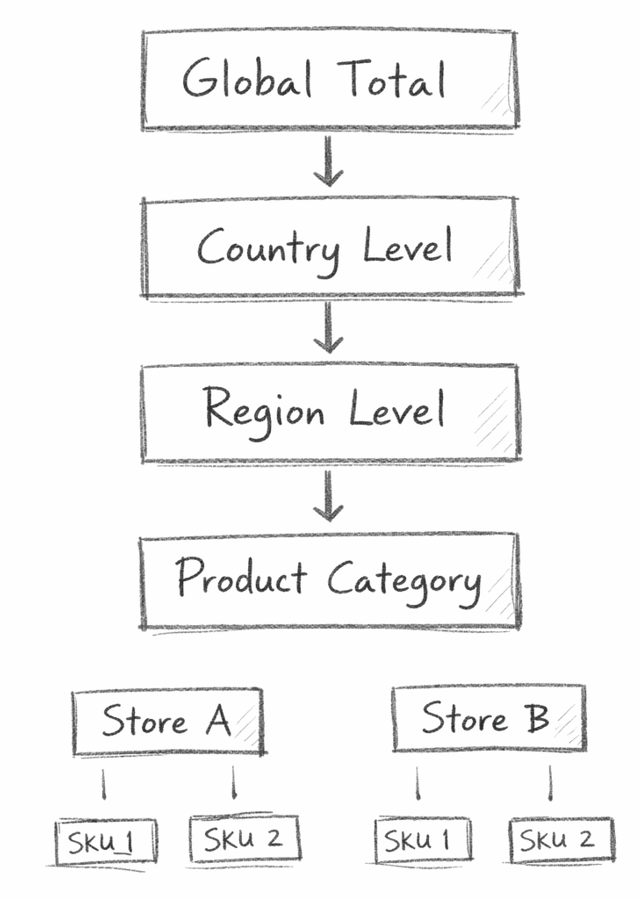
Hand-drawn vertical flowchart showing hierarchy: Global Total → Country Level → Region Level → Product Category, then branching to Store A and Store B with SKU1 and SKU2
Photo generated with ChatGPT

The Coherence Gap

Imagine a scenario where your top-level strategic forecast predicts a 10% growth in a product category due to a new market trend. Simultaneously, the bottom-up statistical forecasts for the individual SKUs within that category suggest a flat trend because the trend’s signal on this more granular level is not strong enough.

If you procure based on the SKU-level data, you may miss the 10% growth target. If you procure based on the top-level 10% target, you won’t know exactly which specific SKUs to stock, leading to imbalances, excess inventory in some items and stockouts in others.

This lack of alignment creates:

  • Operational Friction: Different departments working toward different numbers.

  • Inaccurate Resource Allocation: Capital is tied up in the wrong places.

  • Reduced Trust: Planners lose confidence in the data when the “numbers don’t match.”

How Hierarchical Reconciliation Solves This

Hierarchical reconciliation is the statistical process of adjusting forecasts across all levels of a business hierarchy to ensure they are perfectly consistent. It ensures that every sub-level sums exactly to the level above it.

There are three primary ways to approach this:

  1. Bottom-Up: Forecasts are generated at the most granular level (SKUs) and summed upward. While accurate for operations, this often ignores high-level market trends.

  2. Top-Down: A forecast is generated at the highest level and “pushed down” to lower levels. This captures trends well but often fails to account for specific SKU-level volatility.

  3. Optimal Reconciliation (The Hybrid Approach): This is the method used by modern AI systems. It looks at the uncertainty and historical accuracy of forecasts at every level simultaneously. It then makes the smallest possible mathematical adjustments to create a coherent result.

Now the numbers come together like puzzle pieces forming a complete picture.

A critical, often overlooked benefit of this approach is the top-down influence of measurable trends. Significant market drivers, like a sudden change in consumer behavior or a macro-economic shift, are often clearly measurable at the category or country level, while they remain “invisible” or appear as random outliers at the SKU level. Hierarchical reconciliation allows these high-level insights to “trickle down.” By reconciling the levels, the AI can inject the strength of the high-level trend into the granular forecasts, improving the accuracy of individual SKU predictions before the local data even catches up.

Let’s have a look how this works in prognotix!

Column Configuration screen showing table with Date, Country, Product, Subcategory, Sales and a Perform Validation button.
Assigning levels to the data in prognotix

Defining the Hierarchy

Our AI Forecasting Platform automates this alignment to ensure that forecasts flow conistently into different decision processes.

We start by mapping the relevant levels to the data. In our example, we assign levels 1–3 to country (1), product (2), and subcategory (3). However, these levels can be flexibly arranged in a different order or extended across additional levels, depending on the use case.

Training the Models & Capturing Trends

Once the data is prepared, prognotix provides a “best fit” recommendation based on the historical volatility of your data levels. During training, the system identifies which levels hold the strongest “signal.” If the category level shows a clear upward trend that the SKU level hasn’t recognized yet, the reconciliation process ensures that the SKU-level forecast is intelligently adjusted to reflect that reality.

The training output is a single source of truth. Whether an executive opens a high-level dashboard or a warehouse manager looks at a replenishment list, the data adds up perfectly.

Interface table listing Level 0–3 training rows with prediction Sales, categories Country/Product/Subcategory, forecast frequency MONTH 6x3, and status icons.
Training a hierarchical forecast in prognotix
Bubble chart with a blue bubble selected; tooltip shows training metrics Stability 98% and Accuracy 91% and a level legend.
Visualize hierarchical forecast results in prognotix

Reviewing Coherent Results

Hierarchical reconciliation is not just a mathematical exercise, it is a tool for organizational alignment. By ensuring that every level of the supply chain is working from the same reconciled data set, enriched by trends captured at every level, prognotix eliminates silos and ensures tactical metrics always align with strategic KPIs.

One Version of the Truth

At its core, hierarchical reconciliation turns data conflict into organizational clarity. It bridges the gap between high-level strategic goals and granular operational realities, ensuring that subtle trends discovered at the top improve the precision of the bottom.

With prognotix, this complex statistical balancing act becomes an automated, intuitive part of your workflow. The result is a supply chain that speaks a single language, from the boardroom to the warehouse, backed by one single source of truth.