

From Forecast to Decision: Introducing Inventory Optimization in prognotix

Every Monday, somewhere in a planning department, the same scene plays out. A planner pulls up a clean, accurate demand forecast. The numbers are good. The hard part comes next: turning that forecast into actual orders. What do I reorder today? How much? And can it wait until next week, or will waiting cost me?

For a handful of products, an experienced planner can hold the answer in their head. For a catalogue of thousands of articles, each with its own lead time, its own supplier minimums, its own seasonality, that mental math quietly breaks down. And when it breaks down, it tends to break in one of two expensive directions.

Photo by Tiger Lily @ pexels.com

Why this challenge matters

In project after project, we’ve watched good forecasts fail to deliver their full value for a simple reason: a forecast only saves money when it changes a decision. If the planning team can’t translate it into the right order at the right moment, the insight stays trapped in a spreadsheet.

When that translation happens by hand, it usually produces one of two errors. The first is ordering too late, the stock runs out, a line stops, a customer order slips, and suddenly you’re paying for express freight or losing the sale entirely.

The second is over-buffering “just to be safe.” That feels prudent, but it ties up cash, fills shelves with inventory that may sit for months, and inflates holding costs across the whole catalogue.

Both errors cost real money. Both bind cash flow. And both are nearly impossible to avoid manually once you’re managing more than a few SKUs, because the planner simply can’t see the whole picture at once. Items slip through. A reorder gets missed, and the stockout only becomes visible after it’s already happened.

Introducing Inventory Optimization

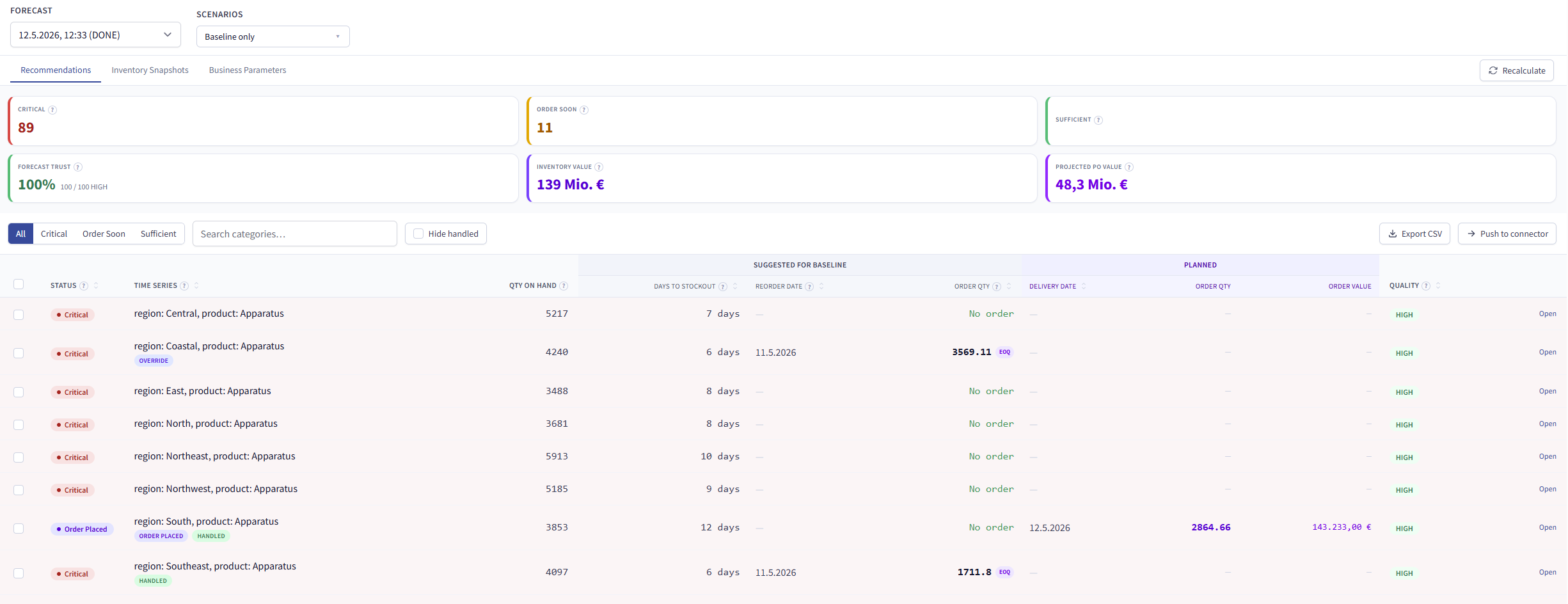
Inventory Optimization is a new module in prognotix that picks up where the forecast leaves off. In plain terms, it turns a finished demand forecast into concrete ordering decisions, article by article. It answers the three questions a planner actually has to act on: what to order, how much to order, and by when.

This is the first of what we’re calling solution modules, the step that moves prognotix from delivering numbers to supporting the decisions those numbers should drive. It’s also why now is the right moment to launch it. The platform already produces strong forecast quality; Inventory Optimization is what converts that quality into value you can see on the balance sheet.

How it works

The module doesn’t just read a single forecast number for each article. It reads the forecast together with its confidence interval, the realistic range of what demand could be. That distinction matters, because real planning lives in the uncertainty.

On top of that range, you set the parameters that reflect how your business actually runs: service levels, minimum order quantities, holding costs, order costs, and lead times per article. The module then calculates the optimal order quantity and the optimal timing across all of your articles at once, something that’s straightforward for math but, as our team puts it, falls apart for a human somewhere past the third or fifth SKU.

Photo by Tiger Lily @ pexels.com
A clear view on your inventory and the decisions to take

The most important lever here is the service level, essentially, with what probability do you want to be able to fulfil demand, and how often is a stockout acceptable?

This is where it gets honest. There’s no setting that gives you maximum availability and minimum inventory at the same time; the two pull against each other. Push the service level toward 100% and your safety stock climbs steeply. Accept a lower service level and you free up capital, but you take on more stockout risk. Inventory Optimization makes that trade-off explicit and finds the best balance for the target you choose, rather than pretending the trade-off doesn’t exist. Most teams start by optimizing toward a single goal, then layer in more once they trust the engine.

Trust, in fact, is built into the design. Every recommendation is explainable: the formulas, the inputs, the data sources, and the full change history are all visible in the interface for any planner who wants to look. Nothing is a black box, and every number can be traced back to where it came from.

Key benefits and outcomes

Because the optimization lives inside prognotix, you get the whole path, data to forecast to ordering decision, in one place, with no tool break and no fragile hand-offs between systems. That means full traceability from “where did this forecast come from and with what settings” all the way through to the order recommendation, with none of the integration risk that comes from stitching two separate tools together. The practical results customers care about:

  • Fewer stockouts, relative to the service level you actually want
  • Less capital tied up in inventory, because buffers are sized to real demand uncertainty instead of gut feel.
  • No more reorders slipping through the cracks, with proactive warnings before a stockout forms.
  • Decisions you can defend, thanks to recommendations that are transparent and fully auditable.

A scenario you might recognise

Picture a mid-sized manufacturer with a few thousand active components. Today, two planners work through the catalogue by judgment and experience. Fast-moving parts get attention; the long tail gets a generous buffer “to be safe.” The result is predictable, occasional surprise stockouts on items nobody was watching, alongside a warehouse holding months of slow movers.

With Inventory Optimization, those same planners set a 97% service level on critical parts, accept a lower level on the long tail, and let the module calculate the timing and quantities across the entire catalogue. The high-risk reorders surface automatically, before they become problems. The over-stocked items get right-sized as buffers shrink to match actual demand variability. The team stops firefighting and starts planning and the capital that was sitting on shelves goes back to work.

From forecast to an optimized inventory in one smooth workflow

What it takes to get started

We’ll be honest about the one real prerequisite: data. The algorithms aren’t the hard part, data provisioning is. To run optimization, your forecast data and your inventory data (current stock, what’s inbound, what’s leaving) need to be available and kept in sync with prognotix, because a recommended order only helps if the system reflects what the planner actually did.

The good news is that a typical project runs from kickoff to measurable results in two to three months. We work closely with implementation partners like paiqo and Cloudflight, both specialists in the data warehouse and data lake foundations this depends on. You can start with planners running ad-hoc optimizations manually in the tool, or automate the full flow via Databricks or Fabric for regular, hands-off recommendations.

What's next

Inventory Optimization is just the first step. Warehouse Optimization is on the roadmap for later this year, optimizing across multiple locations to decide where each article should ideally be stored, balancing factors like travel distances and storage costs. That opens the door for transport and logistics teams.

The direction is consistent: from predicting demand to driving the decisions that follow from it, all within a single platform.